
Charles Emerson Griffin was a man of true devotion.
A jack of all trades and gunfighter who set plans in motion.
Charles was called to act, find a man who had done evil.
Mounting his horse, guns in hand, his demeanor primeval,
Charles went out demanding the wilderness give up the ghost.
He tracked the man to the canyon land, his hidden outpost.
Charles looked down the ridge, the man was armed and ready.
He aimed his gun, the desperate work begun, his hand was steady.
Charles rode and roared, the muzzle of his dragoon he set blazing.
The evil man, his gun in hand, returned fire, hell he sure was raising.
Charles set his sight on the eye where he could see the devil laugh.
His dragoon went boom, singing a song of doom, his head split in half.
Charles sent the man to God, “dispatch him to hell” he did pray.
He returned home, to his ranch to roam, a lion waiting for another fray.
This poem is based on the life of Charles Emerson Griffin, a Utah Pioneer, lawman and gunfighter. Below is an account from his life from his upcoming biography, written by Bradley O. Griffin. (My father, Charles is my two greats grandfather)
Chapter – 14 Sheriff
In his autobiography Charles Emerson Griffin adds what seems to be an almost throw away line. In describing his life in Coalville he added,
“I was ALSO appointed Deputy Sheriff.”
From 1860/61 until about 1875 Charles E. Griffin served in the Sherriff’s Office in Summit County. Each newly elected Sheriff either deputized Charles or he himself was elected as Sheriff. In 1860/61 William Kimball was appointed to be the first Sheriff of Summit County. In the Life Guards there were two battalion commanders. One was Robert T. Burton the other was William Kimball. In a time when most men did not own enough up to date firearms to qualify for service in the militias in Charles E. Griffin, William Kimball recognized a hard riding, well armed, hard case with whom he had served and quickly appointed him as a deputy. Who would you pick? One of the gentleman farmers or a man toughened and tested by his service in the numerous Indian campaigns? Apparently all of the men subsequently elected as Sheriff came to the same conclusion.
Coalville sits within a few miles from the mouth of Echo Canyon. Echo Canyon was the gateway for anyone traveling to and from the Great Basin. A rough and tumble city had sprung up at the bottom of the canyon that served as a way station for the stage lines and US Mail. As a gateway to Fort Bridger, and all points east, Echo Canyon witnessed a good deal of traffic in stolen horses and cattle. Both white and Indian rustlers were involved in the trafficking in stolen animals. Policing this traffic was probably the number one concern of the Summit County Sheriff’s Office. The Sheriffs were also involved with the Militia units patrolling the ancient Indian pathways through the County in the effort to suppress Indian predations. In the wide-open spaces in the American west it took a certain type of rugged individual to “enforce” the law. The prototypical example usually offered is the Texas Rangers. I wonder how many times Charles gathered up his battle gear and headed out on patrol? What kind of a figure did he cut as he approached his adversaries? What goes through your mind as you track a herd of stolen horses? What kind of thoughts race through your mind at the moment of confrontation? The written evidence strongly suggests that he went about his business without any trepidation.
There are only a few incidents in his life where he was motivated to offer a detailed description. One such incident happened while he was serving as a Deputy Sheriff. In explaining the amount of detail he wrote,
“The blame of this whole affair was laid upon me, or the principal part of it, and many threats were made against my life.
I have stated the facts of this case as they existed; and I have been particular in stating them, so that if the story should be told, or even attempted to be told in the future, the facts might be known.”
Charles lists the facts of the case it is left to us to reconstruct the “story”. The story begins at some point on the Oregon Trail east of Echo Canyon. A man traveling with a wagon train that was California bound decided to ride on ahead. At some point he met another group with their wagon. Given the fact that he could later give the names of the men involved seems to suggest that they may have traveled far enough together to exchange that information. At some point the men made the observation that he was in possession of a large amount of cash and robbed him. To rub salt in the wound they also took his mule leaving him afoot.
To his good fortune he met the stage and was able to get ahead of his tormentors the stage traveling faster than the men in their wagon. Arriving at civilization he went in search of the nearest law enforcement he could find in order to swear out a warrant for the arrest of the robbers. At some point he was direct to Charles E. Griffin as a man who could get the job done. By his own account Charles advised the man that his cause would be better served in Salt Lake City with its larger law enforcement capability. Apparently the man was able to persuade Charles to take up his case. From that point forward we see Charles take up a dogged pursuit of the outlaws. It was probably that aspect of his persona that influenced men to select him for service as their deputy.
By 1861 Charles had traded in his warhorses for horses more suited to farm life. Taking his own horse and by stint of taking turns riding and hard walking he and the victim were able to cover enough ground to cut the trail of the outlaws. Having started at sundown they pressed on until midnight when they finally caught up with the outlaws and their wagon where they had pulled over for the night. Pressing on they traveled a few miles more until taking refuge at a mail station where they rested for the reminder of the night. At the mail station Charles was apparently able to secure a ride for the man on into Salt Lake City. He sent him on his way with instructions on how to make connection with the courts in the city.
We get a view of the hardened warrior side of Charles. Recognizing the men involved as they passed, Charles took up their pursuit. He wrote that he overtook them and rode along with them for some distance. During that time what was he doing? Knowing what they were capable of it took some nerve to ride along with them interviewing them without their guessing his motives. Using the distraction of meeting an acquaintance he separated from them and by stint of some hard riding beat them into the Salt Lake Valley where he aided the victim in obtaining a warrant. Apparently he and the victim had gained enough personal information to positively identify the robbers.
Here the story takes a decided turn. The warrant was sworn out in Salt Lake City. His story clearly portrays the city as having a wealth of law enforcement easily capable of dispatching a posse here and a posse there. Given the capabilities of the city officers why was he, by his own account, gone for three weeks on the case? He supplies part of the answer,
“I was deputized to act as deputy and a copy of the warrant was given to me.”
Why was he deputized? Was it because of his familiarity with the men involved or was he deputized because the High Sheriff was Robert T. Burton his former militia commander? With the identity of the men firmly established and plenty of law enforcement available I think it was a little of the former and a lot of the later. From a careful reading of the story I think the two families, involved the McRayes and the Manharts, were well know to law enforcement and had a bad reputation. I think that Robert T. Burton saw in his old campaigner the perfect man to deal with some rough characters.
Thus began a long manhunt. Charles took station at the exit at Emigration Canyon to await the arrival of his quarry. Two of the men did not enter the valley immediately and the other two, the Manharts, managed to elude him. Gathering some intelligence on the two brothers he tracked them to their home in Willow Creek. Armed with the information given them by Charles a posse was dispatched to make the arrest. By his account they served lengthy prison sentences. His narrative seems to suggest that in his pursuit of the four men Charles and his Colt pistols were on their own much of the time. After the capture of the Manharts, Charles turned his attention to the more elusive McReyes. Over a period of days with some dogged detective work Charles was able to track down the two brothers at a home in Salt Lake City. Taking two other officers with him he set out to make an arrest. Sending the other two men, who were on foot, to approach the house Charles, who was mounted, covered the street and avenues of escape. Charles describes the subsequent events,
“Pretty soon I saw one of the deputies running back and forth with a pistol in his hand calling upon some one to stop. In a minute or two he hollered to me and said for me to ride around the block. I had gotten off my horse. I mounted my horse and started around the block. Thinking that our man had gotten into the lot and expecting to see him come out into sight every minute. When about halfway around the block I heard two pistol shots, and of course concluded that they were having desperate work. I kept on until I came to the Northwest corner of the block, and as I came out so as to look south down the sidewalk I saw a man on horse back about two rods (30 ft ) from me and as soon as he saw me began yelling and I saw he had a pistol in his hand which he was waving and swinging about.
As soon as he saw me he drew it on me and snapped it but it missed fired. Before I could stop my horse he ran in behind me and turned east. He then sent a shot at me, which I returned and then I started in pursuit. He proved to be on the faster horse and gained on me.
In going up the hill toward Emigration Canyon, my saddle worked too far back and I was obliged to stop and move it forward and while doing so two men came riding up the hill toward me.
One of them proved to be one of the deputies. When McRaye had gotten on his horse and escaped, this officer had started to follow on foot and kept going until he came across a man riding one horse and leading another. He persuaded the man to let him have the spare horse and they both started in pursuit. I soon joined them and we rode as fast as our horses could go, each putting his horse to its best speed. The deputy taking the lead, I next and the other man last.
After awhile both men were out of my sight, one ahead and the other behind. When I got within three or four hundred yards of the house of young McRaye, at the foot of Little Mountain, I met the head man coming back with the two McRayes as prisoners.
Those are the facts as offered by Charles. The story is one of “desperate work”. The approach to the house provoking an exchange of pistol fire. The story involved Charles whipping his horse around the block all the while in anticipation of a violent confrontation erupting at any moments. It involves facing down an armed man at a distance of thirty feet, bracing himself for a shot taken at close range, dodging a possibly fatal wound because of a misfire. The story includes an exchange of shots as Charles makes it clear he means business. The story includes a long hard ride covering several miles Charles pushing his horse to its limits, Charles handicapped by his slower farm horse and a loose saddle. Can you imagine the reaction on the streets of the city as two men thundered by pistols in hand.
The story takes a sudden twist at the end. One described by Charles,
“Thus terminated the day and that part of the affair altogether different from what I had anticipated.”
On his approach to Little Mountain Charles meets the other deputy who had by then affected the arrest of the two brothers. After the wild shot filled episode in the city how did the single deputy make the arrest? Where the two brothers overwhelmed by the resources in their pursuit? Had the gunfight taken the starch out of them? Whatever the case an arrest was made. Charles notes that the Sheriff with a posse was soon upon the scene. The group stopped to rest and refresh their horses. Charles notes that his old commander mounted a horse in order to ride down to the creek with him. As the party was watering the horses the McRayes, who were by then a ways down the canyon, made a break for their freedom only to be shot dead by members of the posse. And according to Charles,
“Thus terminated the day.”
The key question posed by the story is why the blame for the affair was laid on Charles? The answer must have something to do with his dogged pursuit of the men over the span of three weeks. In the famous movie about Butch Cassidy and the Sundance Kid the catch line was their constant posing of the question as they looked back at their pursuers, “who are those guys”. The Manharts and the McRayes must have posed the same sort of question only this time using the singular “who is that guy” The answer was Charles Emerson Griffin one of the handful of very hard men who tamed the west.
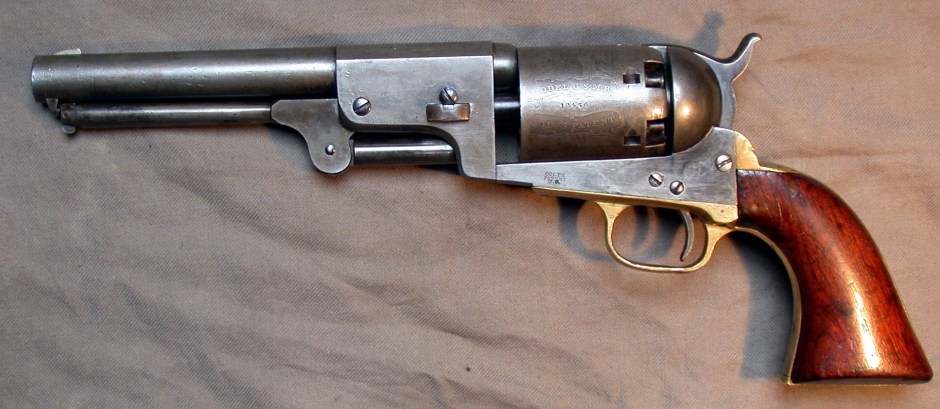
Model 1848 Colt Dragoon, the weapon Charles carried at the time.
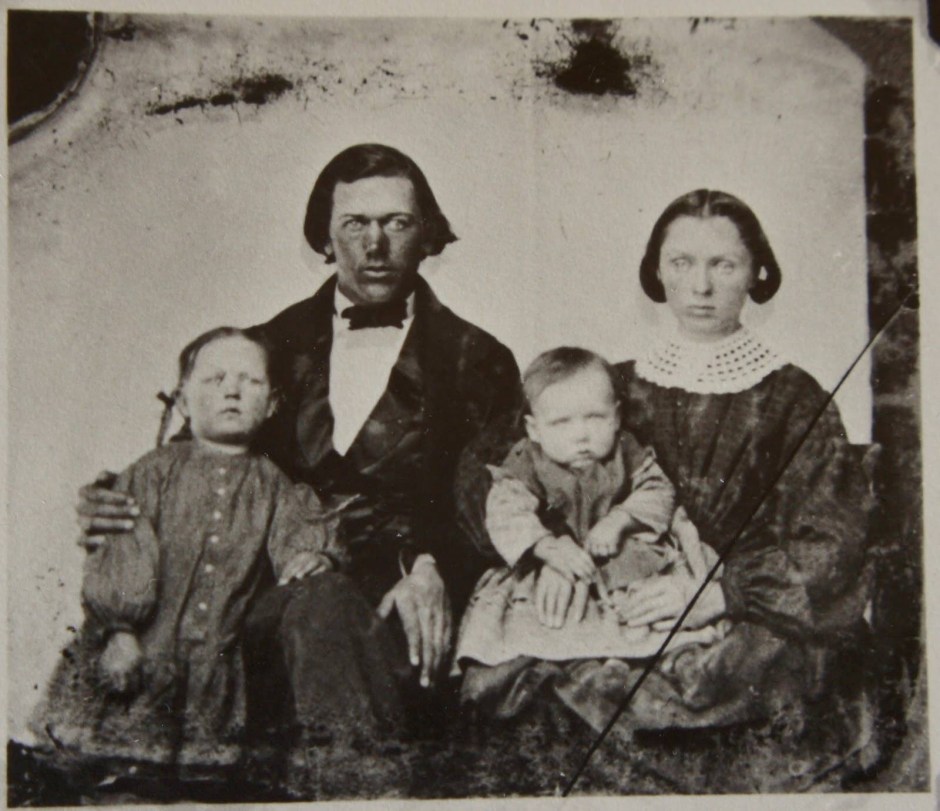 Charles Emerson Griffin, his wife Sarah and their oldest Children, Alice and Joseph.
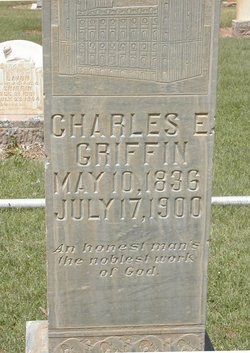
His grave in Escalate, Utah.
 The Pen and Gavel